Hello Reader,
It's a short school break in Singapore this week, just before the major exams, so no travelling for me. I did have a few very interesting meetups though, and the conversations underscored just how far AI now reaches into how we work - and its impact on the future of data centres.
Today, I want to talk about how AI is quietly driving up demand for traditional compute, and how a system that has largely fallen out of favour in data centres is actually well-suited to supporting AI workloads.
AI as a multiplier, not just a GPU story
On Saturday, I wrote about Microsoft's plan to triple its global data centre capacity. It dovetails with my observation over the last 12-18 months: that the hyperscalers have never stopped building new data centres in the region.
But for all the conversation (and unhappiness) about data centres, here's something that gets far less attention: AI doesn't just consume GPUs. It also pulls up demand for everything else. That's right, generative AI not only increases demand for GPUs and AI accelerators, it's also a multiplier on almost every other part of the IT stack, from CPUs and memory to storage and networking.
And the effect isn't confined to the data centre. It ripples across the entire tech ecosystem. Let me give some examples to illustrate my point.
For instance, I have a DGX Spark machine on my desk in the form of the Asus GX10. It runs on Linux, has a massive amount of RAM (128GB), and is rock solid for months at a stretch. It also runs around-the-clock, hosting multiple Claude Code sessions, which often work through the night. On top of that, it's running multiple browsers and tools for testing and development, as well as local LLMs. And oh, code is pushed scores of times a day to GitHub, and when ready, deployed onto internet servers.
Within organisations, enterprise apps are also evolving. Traditional apps work this way:
User request → application server → database query → response
But an AI-enabled app works like this:
User request → authentication → prompt processing → document retrieval → database and vector searches → API calls → business-system queries → tool execution → logging → validation → response generation
A new generation of AI-enhanced apps will hence consume substantially more traditional compute resources. I'm not saying it is bad, but merely that existing IT resources will see a lot more use before the day is up. And this will increase further as AI-native apps become more popular.
Finally, we need to consider AI agents. These are AI systems that work towards a goal and take actions to achieve it. Earlier this week, a friend told me how he used Astra on ChatGPT Work to book airline tickets for his family holiday through the Singapore Airlines website.
Why not do it himself? You know how airline pricing changes across different dates and flights? Well, he had the agent check out scores of permutations based on his plans for the cheapest rates. And oh, he's also using agents to do his holiday planning, with agents spending hours researching holiday destinations through his browser.
Notice the pattern? AI isn't replacing traditional compute; it's generating far more of it.
A second look at DRUPS
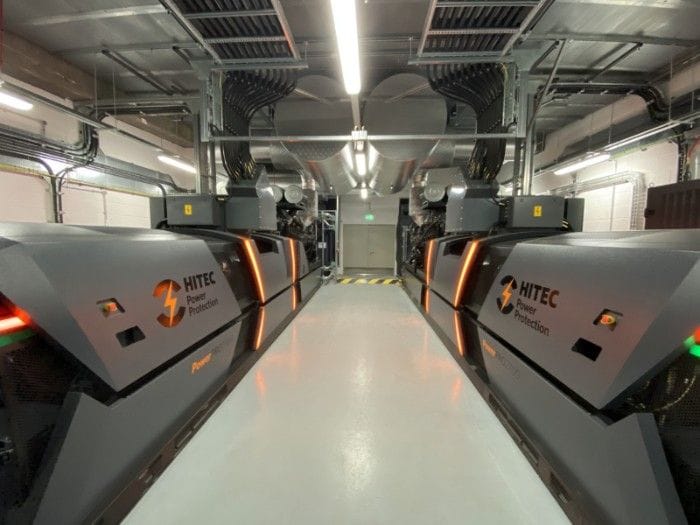
I still remember when I saw my first DRUPS, or Dynamic Rotary Uninterruptible Power Supply. These are power backup systems that eschew chemical batteries in favour of kinetic energy from a spinning flywheel, providing immediate power until the built-in diesel engine comes online.
The use of DRUPS has fallen out of fashion in data centres though. I can only remember two data centres in Singapore that use DRUPS: the Global Switch data centre at Woodlands, which I visited during its opening ceremony, and the Keppel data centre, which I looked into after the Singapore Exchange (SGX) suffered a major power supply failure in November 2014. I wrote about it in "Lessons from the Singapore Exchange failure" here.
I recently spoke with a senior data centre veteran, who kindly shared various insights about DRUPS. Let's just say he has decades of experience designing and managing data centre deployments that use DRUPS for power backup. You can read about "Four reasons data centres shouldn't write off DRUPS" here.
What surprised me was how DRUPS are actually a great fit for cutting-edge AI workloads. It turns out that AI workloads are not just power-hungry, but also electrically violent. Where traditional data centre workloads with lots of unrelated applications create ups and downs that average each other out, a GPU cluster used for AI training moves in lockstep: thousands of GPUs ramp into a compute-heavy phase, then drop into a lower-power communication phase, all at once.
This puts enormous pressure on traditional UPS architectures and accelerates battery wear. A spinning flywheel, on the other hand, is built to absorb precisely this kind of swing.
Or as Tadala Maluwa, a principal design manager at Microsoft in the Netherlands, wrote:
I am one of those fortunate engineers to have had first hand experience with DRUPS. Indeed when you dive into the technicalities of both solutions, you realise that DRUPS are actually not what some in the industry had made them to be (not good enough, in-efficient, etc).
What am I trying to say here? Just that in the rush to build for AI, it's worth asking what actually works for the use case at hand, rather than what sounds modern.
What do you think?
Regards,
Paul Mah