From AI godfather to enemy of the state
 |
Paul Mah
November 22, 2026 |
|
|
In this issue
| 1 |
Digital Realty opens Singapore innovation lab |
| 2 |
Your GPU can save you millions of cloud tokens |
| 3 |
Why the Fold8 is my favourite foldable |
|
|
Hello Reader, |
Exactly as I predicted last weekend, the US moved quickly this week with new laws designed to further block Chinese tech giants from accessing to AI chips. |
Today, let's talk about why I think it would take a minor miracle for Jensen Huang to stay out of jail, much less return to Nvidia. I will also share why the ramifications of the new US laws on Southeast Asia data centres will be both larger and smaller than news headlines would suggest. |
A perfect storm
|
The full-court press against Jensen Huang continues this week with a rapid escalation in legal and congressional scrutiny, while the media onslaught rages unabated across both sides of the partisan divide. |
Here is a short list of the latest developments: |
- California has served investigative subpoena to Nvidia to see whether Nvidia or Jensen may have violated California law.
- The US Securities and Exchange Commission has started preliminary civil investigation to examine accounting issues.
- The Senate Banking Committee Chairman has called for Jensen's public testimony before Christmas.
|
In a nutshell, while the various inquiries (California, SEC, Commerce, DOJ, intelligence, congressional, and board) overlap, they are also distinct and separate. Being embroiled in national security matters is detrimental even if you are a famous billionaire. |
But what explains the multiple waves of media reports? On that front, I think it is a perfect storm of multiple actors with different agendas. |
- Export-control hawks attacking Jensen's approach to GPU sales to China as naive or compromised.
- Democratic lawmakers looking to investigate whether Nvidia received favourable treatment from the Trump administration.
- Competitors potentially benefitting from the uncertainty around Nvidia.
- The general media, because there's sex, there's (allegedly) espionage, China, and a trillion-dollar company. So why not?
|
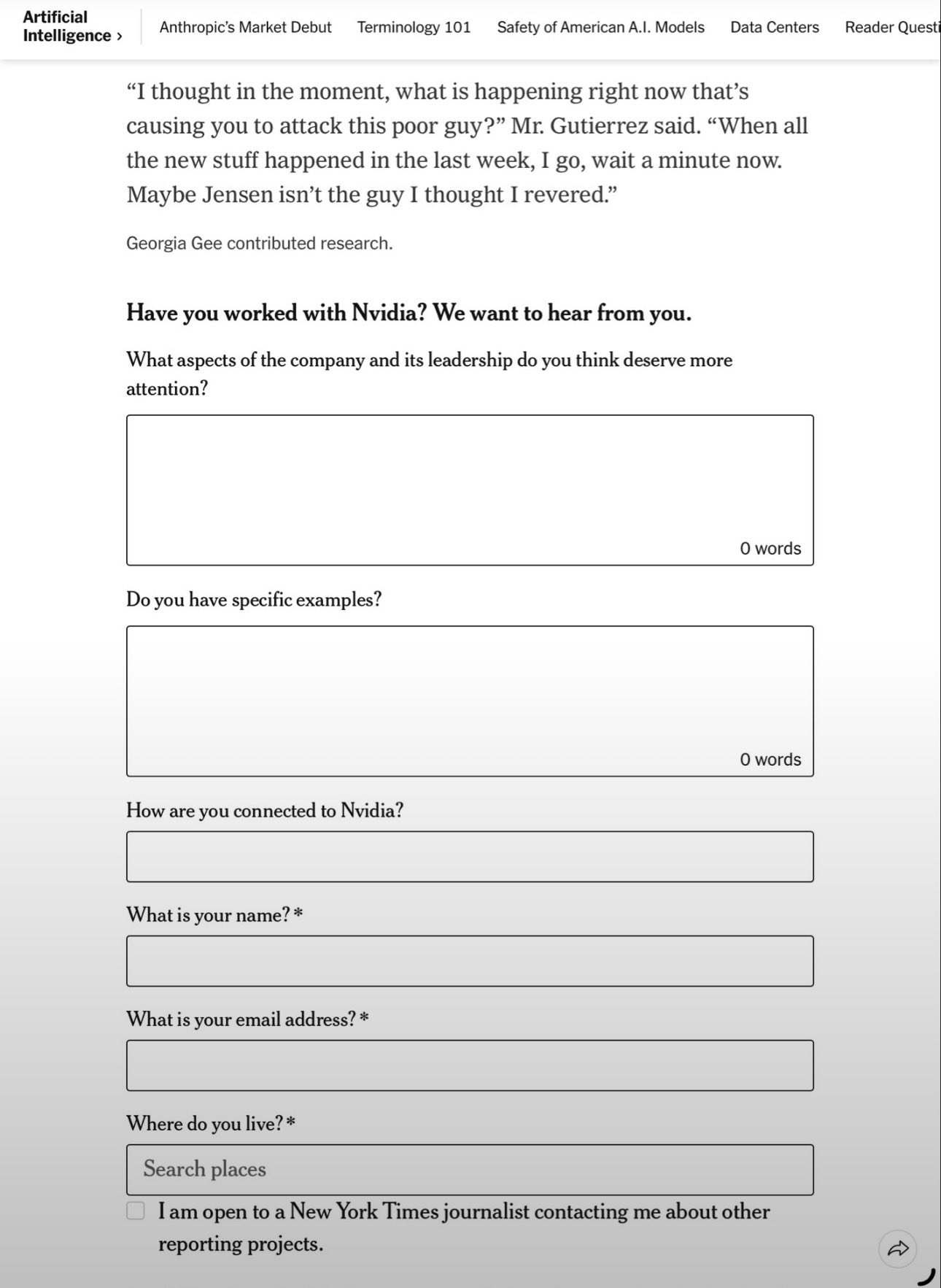
Even the New York Times jumped in with a salacious November 20 report titled “Threats, Insults, Settlements: How Jensen Huang Made Humiliation Routine.” |
According to the report, more than a dozen current and former employees described Huang publicly insulting, belittling, and threatening staff. Only one person is named, though, and he had been fired before making the allegations. Never mind that Nvidia is consistently ranked among the best companies in the world to work for, including in surveys based on anonymous employee feedback. Make of that what you will. |
And oh, the Times likely obtained its feedback from a form like the one below, as shared on X. |
 |
Anyway, the unremitting media reports are already reshaping sentiment. Though I've seen scores of memes mocking the reports from certain publications, a friend showed me a comment on a private forum where an investor derided Jensen for "making me lose thousands of dollars for having an affair with a spy." |
Things may yet play out differently over the next few weeks, but I'm certainly not betting on it. |
|
Tech Stories is on WhatsApp. Join 2,000 others; nobody sees your number. |
|
|
Why the US won't back down
|
One reason I wrote so much about Jensen Huang is to get it off my chest. The other is to highlight the tremendous political pressure in the US to block China from AI chips. Last week, I wrote that the US sees the AI race as an existential one. But why? RSI. |
Recursive self-improvement, or RSI, is a process where AI systems help design, train, or optimise more capable versions of themselves. As AI helps build better AI, improvements in AI models will arrive even faster than before. In a way, this is already happening, judging by the increasing cadence at which more capable AI models are being released. |
For the US, RSI matters as it could determine who leads the next technological era. Simply put, being first to RSI is all that matters; the exponential rate of improvement it promises to deliver will mean that even a close follower with far greater industrial capacity (think China), will be left hopelessly in the dust. |
If you apply this lens, then all the laws designed to temporarily delay China by limiting access to semiconductor equipment and cutting-edge AI chips - they all make perfect sense. Because it won't matter if China catches up in two or three years' time. |
What is the near-term impact on Southeast Asia data centres then? You might have seen reports of Moonshot AI cancelling a US$150 million Nvidia B300 GPU rental deal. On the surface, it would appear that the data centre industry is imploding. But to put that in perspective, did you know that this is barely enough to purchase 3-4MW of GPU servers - excluding data centre build-out? |
So yes, it is a certainty that some deals will be lost, though nobody actually knows how many. But I think the reduced pressure to rush data centres out could have a positive, long-term impact, by giving the region more time to absorb new capacity and ensuring adequate build-out for both traditional and AI use. |
In short, the hit will likely be smaller than the headlines suggest. The long-term payoff could be larger: data centre growth that is built for the region's own needs. |
Would love to hear your thoughts. |
PS: I hope you liked the new newsletter layout. |
|
Regards,
Paul Mah
|
|
 |
|
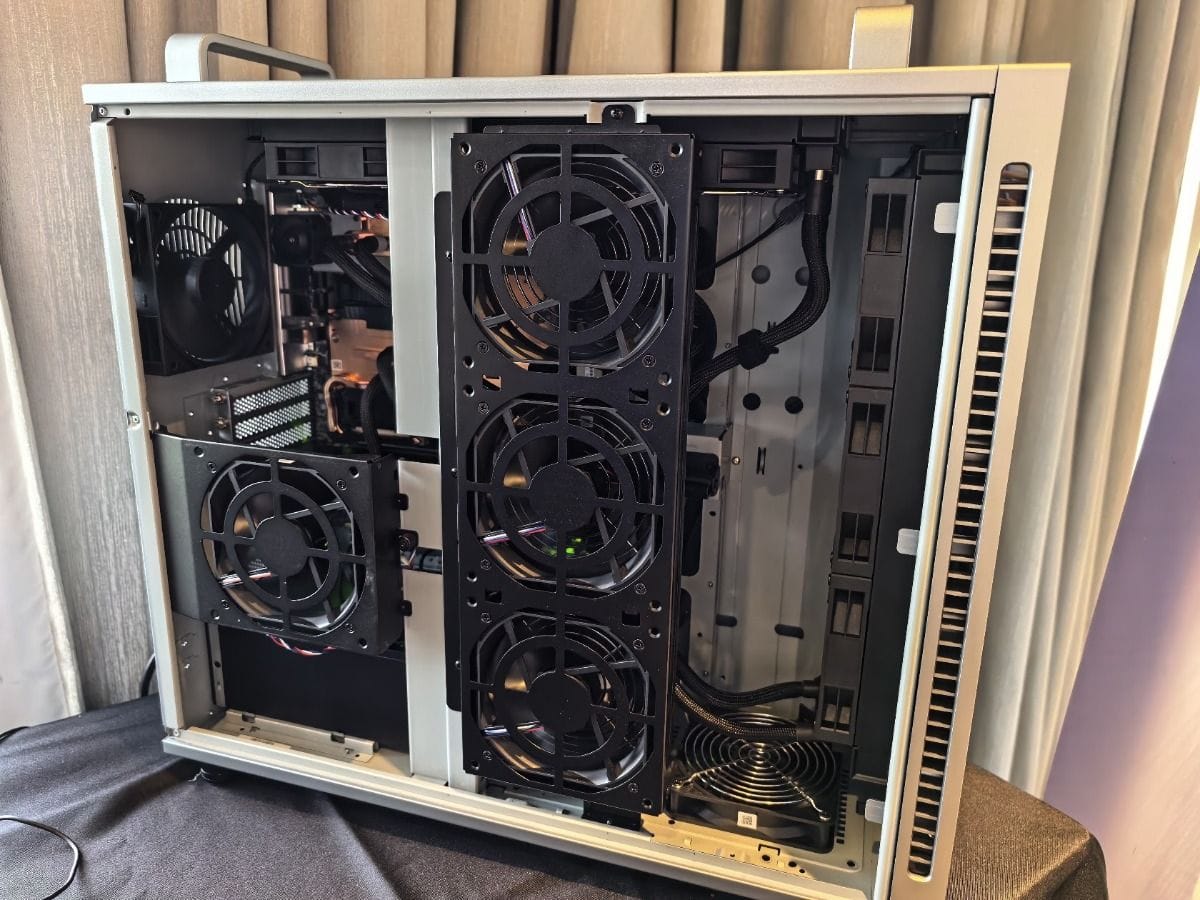
Liquid cooling, multi-vendor stacks, and a path to Jurong Island.
|
|
 |
|
The token maths behind running agents on a consumer card.
|
|
 |
|
Passport-sized, 201 grams, and Samsung DeX built in.
|
| |
|